Present Situation and the Path Forward
The efforts made since 1959 by Tibetans, by China and by the international community to resolve the conflict: dialogue with the leaders of the Chinese Communist Party, the delegations, the advocacy that has succeeded and the laws parliaments have passed, such as the Resolve Tibet Act of 2024. And the situation inside Tibet today.
ད་ལྟའི་གནས་བབ་དང་མ་འོངས་ཀྱི་མདུན་ལམ།
Chronology
1959–1960 · The jurists’ findings
The International Commission of Jurists, a Geneva-based body of lawyers, reported in 1959 and 1960. Its Legal Inquiry Committee found that acts of genocide had been committed against Tibetans as a religious group, and that Tibet had been at least a de facto independent state when China invaded.
1959, 1961, 1965 · The United Nations speaks
The UN General Assembly adopted three resolutions on Tibet: 1353 (XIV) in 1959, by 45 votes to 9; 1723 (XVI) in 1961, by 56 to 11; and 2079 (XX) in 1965, by 43 to 26. They called for respect for the human rights and distinctive culture of the Tibetan people, and the 1961 resolution called for an end to practices depriving Tibetans of their right to self-determination.
1979–1985 · Fact-finding delegations
After Deng Xiaoping said in 1979 that ‘apart from independence, all issues can be discussed’, Beijing accepted four fact-finding delegations from exile, which Tibetans received with huge enthusiasm. Exploratory talks in Beijing in 1982 and 1984 led nowhere, and formal contact ended in 1993.
1980 · Hu Yaobang admits failure
After visiting Lhasa, Chinese Communist Party General Secretary Hu Yaobang acknowledged that Chinese policy in Tibet had failed and allowed a limited revival of religion and culture.
21 September 1987 · Five Point Peace Plan
Before the US Congressional Human Rights Caucus, the Dalai Lama proposed making Tibet a zone of peace, ending Chinese population transfer, respecting human rights, protecting the environment and beginning negotiations.
14 October 1987 · European Parliament backs the Five Point Plan
Weeks after the Dalai Lama set out his Five Point Peace Plan, the European Parliament urged China to respect Tibetans’ religious freedom and cultural autonomy. It declared that the plan could well form the basis of a settlement, the first of many European Parliament resolutions on Tibet.
15 June 1988 · Strasbourg Proposal
At the European Parliament the Dalai Lama proposed a self-governing democratic Tibet in association with China, the first public proposal setting out the Middle Way Approach conceived in 1974.
1989 · Nobel Peace Prize
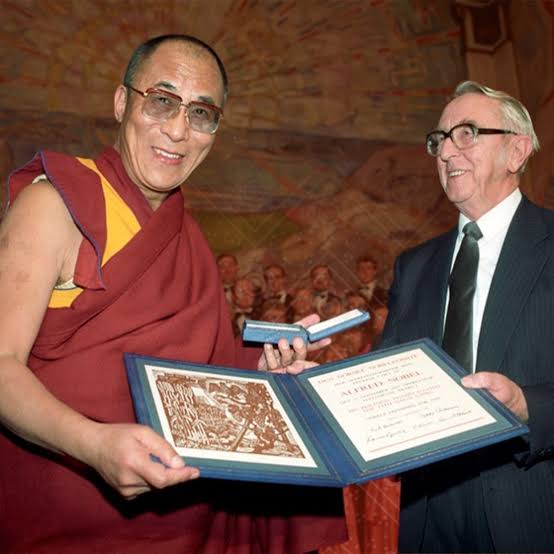
On 5 October 1989 the Norwegian Nobel Committee announced that the Fourteenth Dalai Lama would receive the Nobel Peace Prize, presented on 10 December, for his non-violent struggle for the liberation of Tibet and his advocacy of peaceful solutions based on tolerance and mutual respect.
23 August 1991 · Tibet returns to the UN agenda
The UN Sub-Commission on Prevention of Discrimination and Protection of Minorities adopted resolution 1991/10, “Situation in Tibet”. It voiced concern at violations that threatened the distinct cultural, religious and national identity of the Tibetan people and called on China to respect their fundamental rights. It was the first UN resolution on Tibet since 1965.
9 October 1991 · The Dalai Lama offers to visit Tibet
Speaking at Yale University, the Dalai Lama proposed a visit to Tibet to help lay the basis for a negotiated solution. He warned that Beijing’s refusal to respond to his efforts was testing the patience of young Tibetans with the non-violent path.
1992–1993 · Letters to Deng and Jiang; Beijing cuts contact
On 11 September 1992 the Dalai Lama wrote to Deng Xiaoping and Jiang Zemin with a 13-point memorandum explaining his position. Two envoys, Gyalo Thondup and Sonam Topgyal, delivered it in Beijing in July 1993, but in August 1993 Beijing severed all formal channels of communication with Dharamsala. Contact did not resume until 2002.
18 September 1997 · Tibetans entrust the way forward to the Dalai Lama
After contact with Beijing was broken, the Dalai Lama proposed that Tibetans decide the course of their struggle by referendum. In a preliminary poll more than 64 per cent said no referendum was needed and backed the Middle Way, the policy of genuine autonomy chosen in 1974. On 18 September 1997 the exile parliament resolved unanimously that the Dalai Lama’s decisions on Tibet would carry the weight of a referendum.
6 July 2000 · European Parliament sets Beijing a deadline
The European Parliament called on EU member states to consider recognising the Tibetan Government in Exile as the legitimate representative of the Tibetan people if Beijing and the exile government had not reached an agreement on a new status for Tibet within three years.
2002–2010 · Dialogue without result
The Dalai Lama’s envoys, Lodi Gyari and Kelsang Gyaltsen, held nine rounds of talks with Chinese officials. In November 2008 they presented the Memorandum on Genuine Autonomy, which Beijing rejected. No talks have been held since the ninth round in early 2010.
30 September 2002 · The Tibetan Policy Act
The United States made dialogue between Beijing and the Dalai Lama’s envoys the central aim of its Tibet policy. The law also created the post of Special Coordinator for Tibetan Issues in the State Department, charged with protecting Tibet’s distinct religious, cultural, linguistic and national identity.
2007 · Control over reincarnation
China issued rules requiring state approval for the recognition of reincarnated lamas, a claim of power over Tibetan Buddhism that it now uses against the Dalai Lama’s succession.
2007 · “Free Tibet 2008”
On 25 April 2007 Students for a Free Tibet activists, among them the Tibetan Tendor, unfurled a banner reading “One World, One Dream, Free Tibet 2008” at Everest base camp, where China planned to take the Olympic torch, and were detained. In August, as Beijing counted down to the Games, six SFT members hung the same message on the Great Wall of China.
17 October 2007 · Congressional Gold Medal
In the Capitol Rotunda in Washington, the Dalai Lama received the Congressional Gold Medal, the highest civilian award of the US Congress, with President George W. Bush and Speaker Nancy Pelosi taking part. The Central Tibetan Administration ranks the day with the 1989 Nobel Peace Prize as a milestone in the freedom struggle.
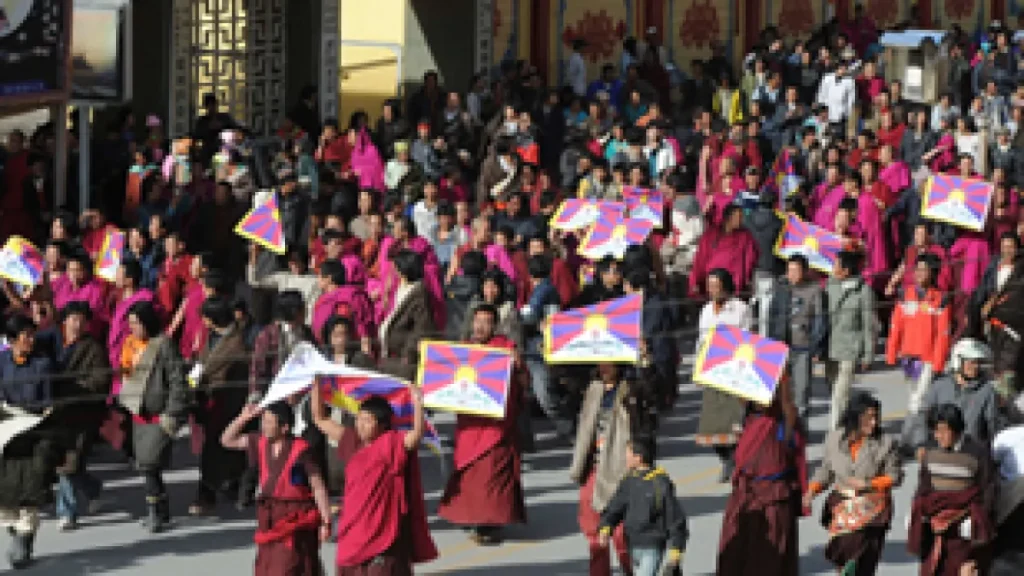
2008 · Protests across Tibet
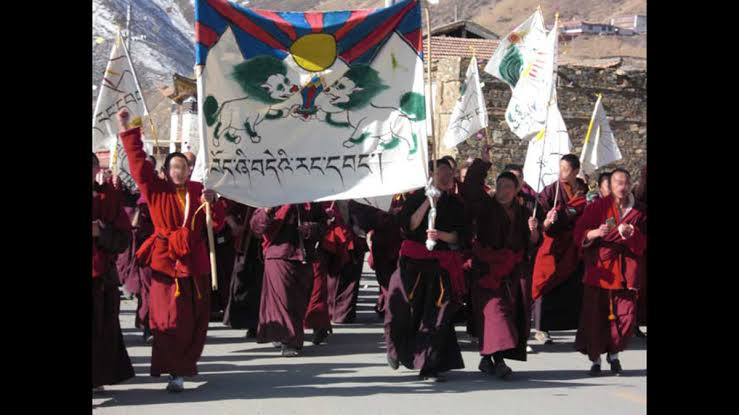
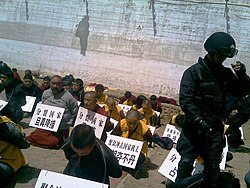
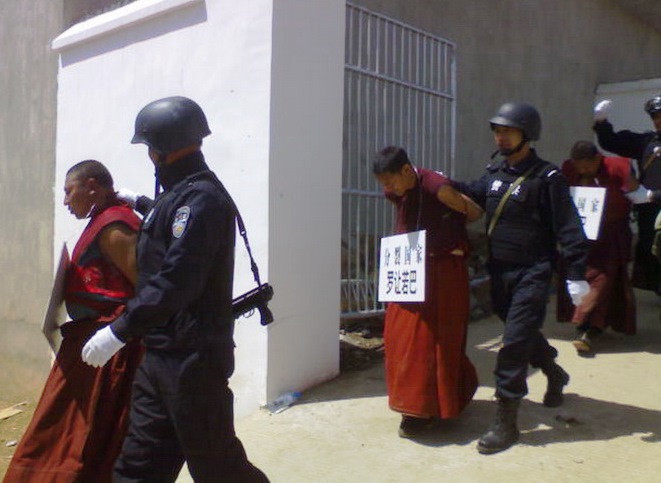
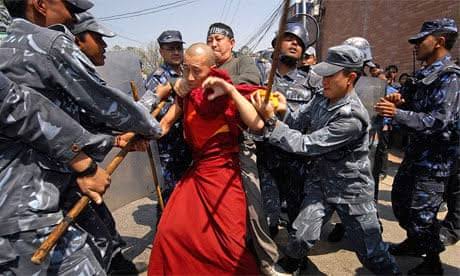
From 10 March 2008 protests spread from Lhasa across all three provinces in the months before the Beijing Olympics. The Central Tibetan Administration’s research estimates that 227 Tibetans died in the crackdown, more than 6,810 were arrested or detained, and over a thousand disappeared. Human Rights Watch documented Chinese security forces firing on protesters.
March–April 2008 · The torch relay meets Tibet
As the uprising spread across Tibet, Tibetans lit their own Tibetan Freedom Torch at Olympia and protested at the lighting of China’s Olympic torch there. Protests then followed the torch around the world: in London on 6 April supporters lined the route with Tibetan flags, and in San Francisco SFT activists climbed the cables of the Golden Gate Bridge to hang banners reading “One World, One Dream” and “Free Tibet”.
17–22 November 2008 · A people’s mandate for the Middle Way
After the 2008 crackdown, nearly 600 representatives met in Dharamsala for a six-day Special Meeting, with written views gathered from exile communities and from Tibetans inside Tibet. More than 80 per cent backed the Middle Way, the third time Tibetans had endorsed it through a democratic process.
2009 onwards · Self-immolation protests
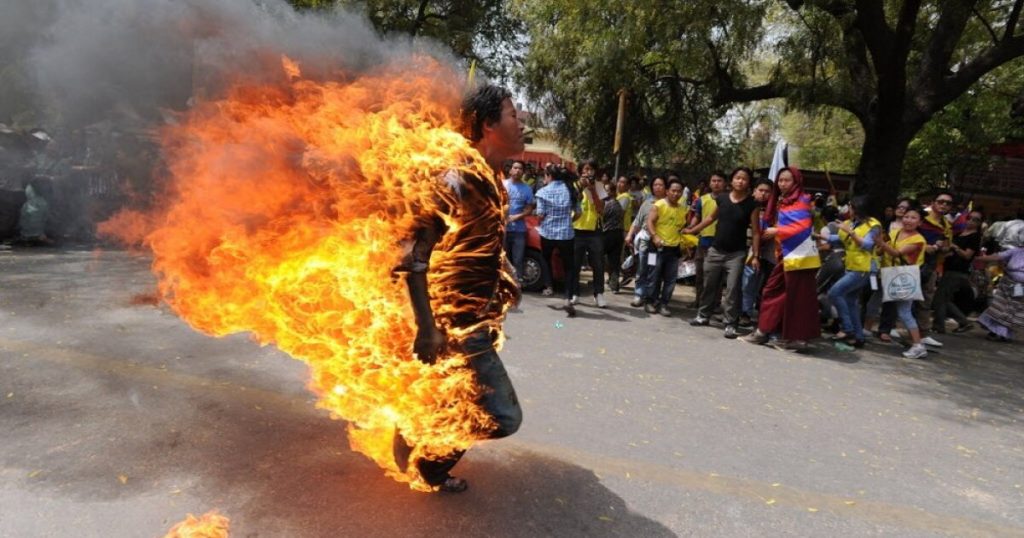
On 27 February 2009 a young monk of Kirti monastery in Ngaba (Ch. Aba) set himself alight. The Central Tibetan Administration has recorded 157 self-immolations inside Tibet since then, at least 136 of them fatal; most protesters called for freedom and the return of the Dalai Lama.
26 January 2010 · The Note on the Memorandum
At the ninth round of talks in Beijing, the Dalai Lama’s envoys presented a Note answering Beijing’s objections to the 2008 Memorandum on Genuine Autonomy. It restated that the Dalai Lama does not seek independence and that Tibetans ask to be governed as one people within a single autonomous administration. Beijing has held no talks since.
2011 · Democracy in exile
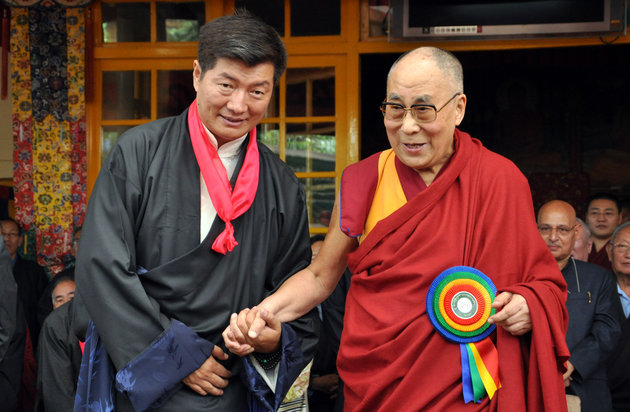
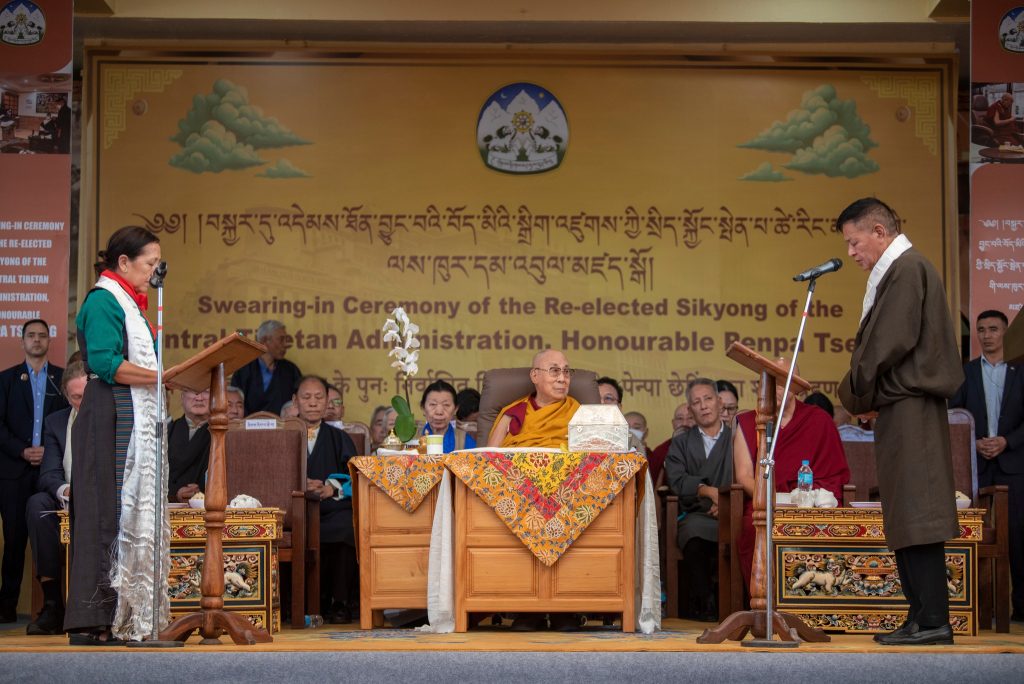
In March 2011 the Dalai Lama handed his political authority to elected leaders, and on 29 May 2011 the Tibetan Parliament-in-Exile amended the Charter accordingly. The elected political leader, the Kalon Tripa (retitled Sikyong in 2012), now leads the Central Tibetan Administration.
2 November 2012 · UN rights chief speaks on Tibet
High Commissioner Navi Pillay urged China to address the deep-rooted grievances behind the self-immolations, release detainees and admit independent monitors and media.
29 March 2013 · Gyama mine disaster
A landslide at a Chinese state-owned mine east of Lhasa buried 83 workers, exposing the human and environmental cost of mining in Tibet.
2016 onwards · Forced relocations
Chinese authorities began moving whole villages in the so-called TAR in the name of poverty alleviation and ecology. Human Rights Watch found the moves coercive.
August 2018 · UN anti-racism review
At the UN Committee on the Elimination of Racial Discrimination, Tibetan groups set out restrictions on movement, passports, language and religion, and challenged the Chinese delegation’s denials.
19 December 2018 · Reciprocal Access to Tibet Act
After unanimous votes in both houses of Congress, the United States enacted a law demanding that Americans, including diplomats, journalists and Tibetan-Americans, have the same access to Tibet that Chinese citizens enjoy in the US. The State Department must report each year on Chinese officials who keep Americans out of Tibet, and those officials are barred from US visas.
27 December 2020 · Tibetan Policy and Support Act
A new US law made it official policy that only the Dalai Lama, Tibetan Buddhist leaders and the Tibetan people can decide his succession, with sanctions for Chinese officials who interfere. It recognised the Central Tibetan Administration and its Sikyong, barred new Chinese consulates in the US until a US consulate opens in Lhasa, and called for regional cooperation on Tibet’s rivers.
2023 · Colonial boarding schools
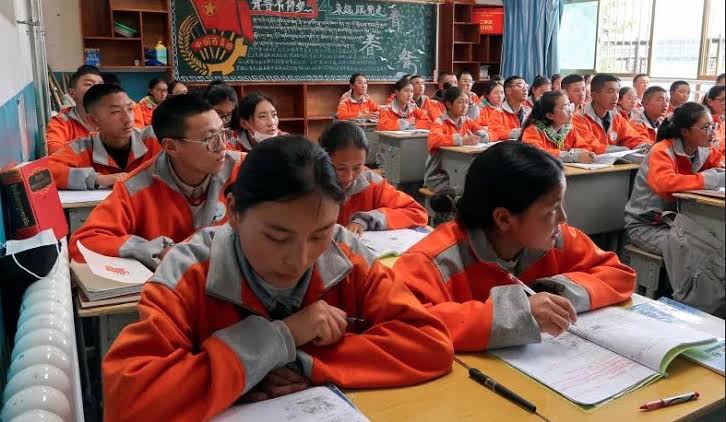
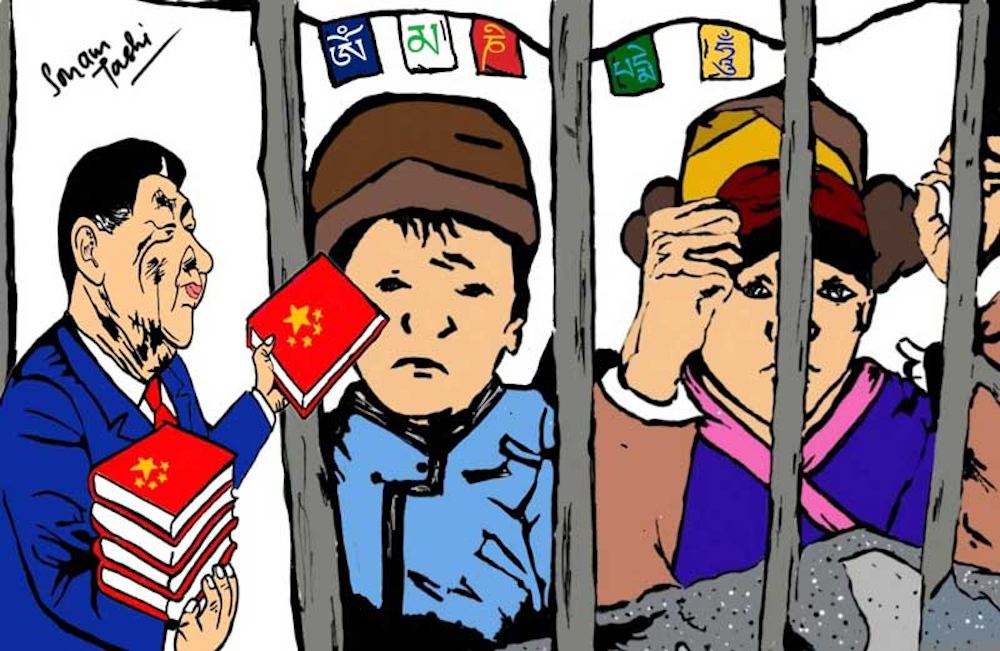
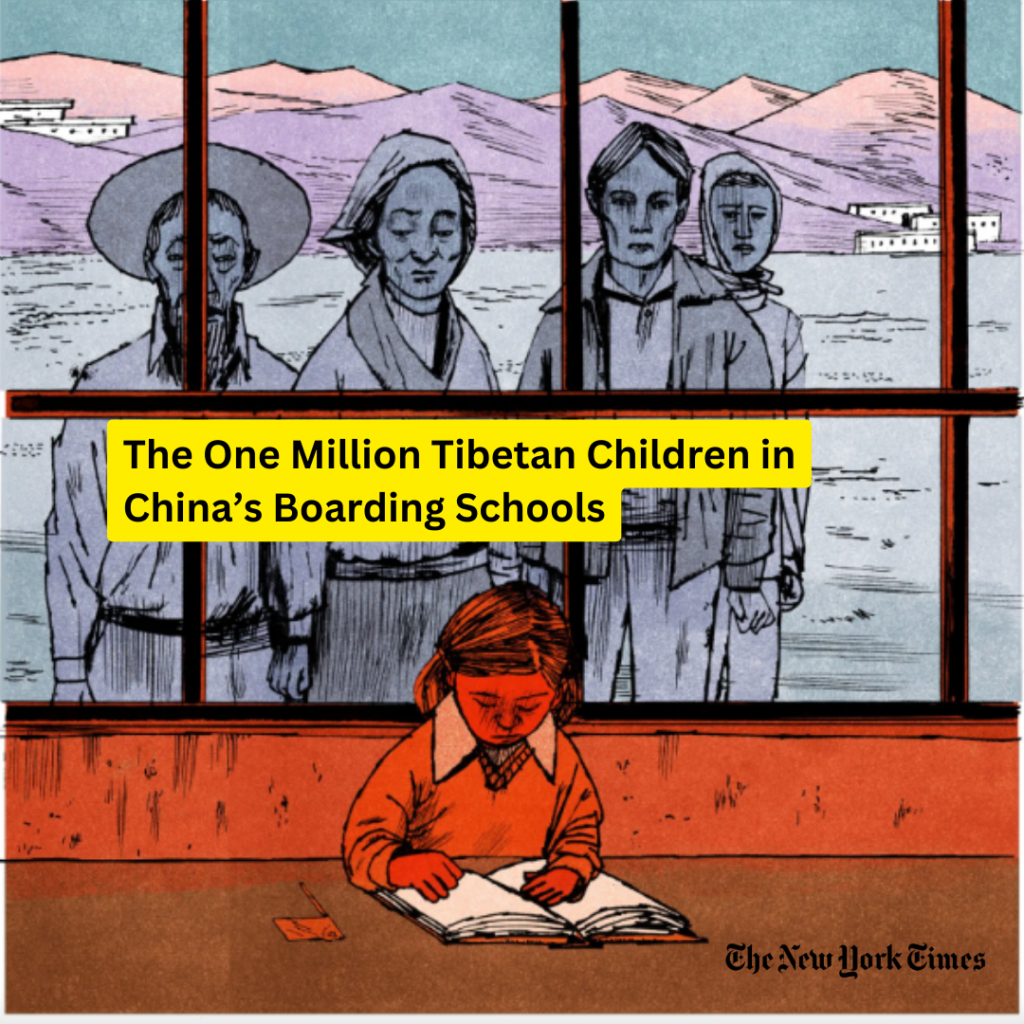
In February 2023 UN independent experts said about a million Tibetan children were in a state residential school system that appeared designed to assimilate them culturally, religiously and linguistically. In March 2023 the UN Committee on Economic, Social and Cultural Rights called for the system to be abolished.
2023 · UN scrutiny grows
In April 2023 UN independent experts raised the alarm over labour transfer programmes that push Tibetans into work and training under coercive conditions, adding to their warnings that year about the colonial boarding schools.
Late 2023 · Erasing the name ‘Tibet’
Chinese state documents and media began replacing ‘Tibet’ with ‘Xizang’ in English, an attempt to separate the region from the idea of Tibet itself.
February 2024 · Kamtok dam protests
Chinese authorities detained at least 300 Tibetans in Derge after peaceful protests against a dam that would flood villages and monasteries.
12 July 2024 · Resolve Tibet Act
A new US law urged China to resume dialogue with the Dalai Lama’s representatives and backed efforts to counter Chinese disinformation about Tibet’s history.
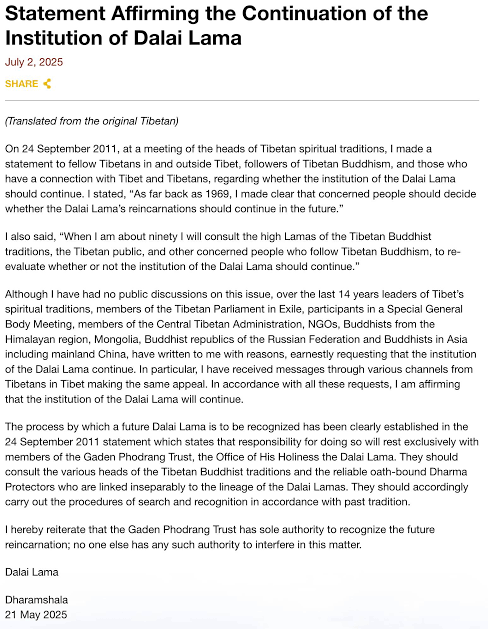
2 July 2025 · The Dalai Lama on his succession
In a statement released on 2 July 2025, the Dalai Lama affirmed that the institution of the Dalai Lama will continue and that the Gaden Phodrang Trust has ‘sole authority to recognise the future reincarnation’. Beijing again claimed the right to choose the next Dalai Lama, which Amnesty International called interference in Tibetan religious life.

6 July 2025 · The Dalai Lama turns 90
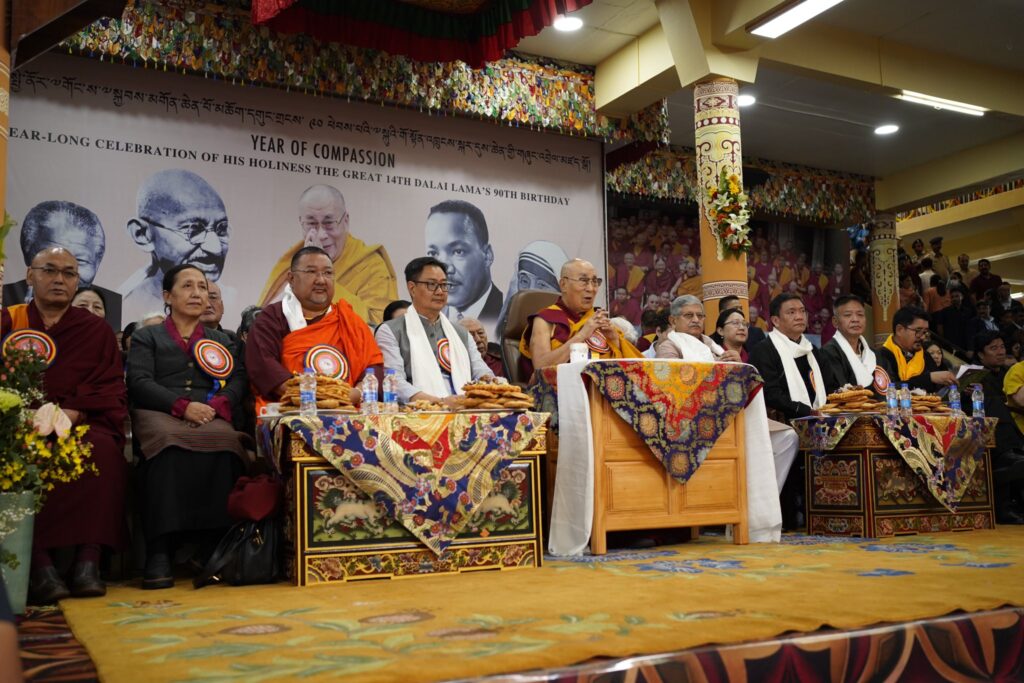
The Dalai Lama celebrated his 90th birthday in Dharamsala on 6 July 2025 with thousands of Tibetans and friends from around the world. Human Rights Watch reported tightened restrictions at monasteries inside Tibet around the anniversary.
March–July 2026 · ‘Ethnic unity’ law
China adopted a national law on ethnic unity and progress, in force from 1 July 2026. The UN High Commissioner for Human Rights called for its repeal.
September 2026 · New hardliner in Lhasa; protests in Washington
Hu Changsheng became Party Secretary of the so-called TAR, pledging to deepen the ‘anti-separatist struggle’, while thousands of Tibetans and supporters rallied on Capitol Hill during Xi Jinping’s state visit to the United States.
Tibet Today
Recent reports from Tibetan organisations, the United Nations, human rights groups, governments and the press. Every item is dated and links to its source. Because China blocks independent access to Tibet, much of this information reaches the world at great risk to the Tibetans who share it.
Deadly earthquake strikes Drachen in Nagchu
2026-10-23
A magnitude 7.0 earthquake struck Drachen County in Nagchu at about 10:33 p.m. on 22 October 2026. Chinese official figures gave at least 16 dead and 76 injured; local sources reported more than 20 deaths and villages almost entirely destroyed. The Central Tibetan Administration said Tibetan volunteers were reportedly being kept from the area and urged China to allow aid and independent access.
Central Tibetan Administration
Arson attack on the Office of Tibet in Pretoria
2026-10-20
The Office of Tibet in Pretoria, South Africa, was hit by an arson attack on 14 October 2026, after a smaller attack on 6 July, the Dalai Lama’s 91st birthday. The Representative and staff escaped unharmed. The Kashag called for a thorough, impartial and timely investigation.
Central Tibetan Administration
Former Ragya abbot jailed for five years over prayers for the Dalai Lama
2026-10-19
Khensur Lobsang Tenpa, a former abbot of Ragya Monastery in Golog, was sentenced to five years in prison, reportedly for performing long-life prayers for the Dalai Lama. He was detained on 5 July 2026, the eve of the Dalai Lama’s 91st birthday. The charges and the court have not been made public.
Central Tibetan Administration
Three more Tibetan schools shut down in Golog
2026-10-17
Chinese authorities closed three privately run Tibetan schools in Machen County, Golog, between late August and early September 2026: a girls’ school of about 800 students, an orphan school caring for more than 300 children, and a village school told that teaching in Tibetan was unacceptable, whose pupils were sent to state boarding schools.
Central Tibetan Administration
European Parliament rebukes Beijing over Tibet
2026-10-07
The European Parliament adopted its report on EU–China relations with 454 votes in favour. It condemns forced assimilation in Tibet, calls for the immediate abolition of the residential school system that separates nearly one million Tibetan children from their families, opposes Beijing’s interference in the Dalai Lama’s succession and asks where the Panchen Lama is.
Central Tibetan Administration
US lawmakers in Dharamsala condemn the ‘ethnic unity’ law
2026-09-30
After an audience with the Dalai Lama, a five-member bipartisan delegation of the US House of Representatives led by Brian Mast raised concern over China’s ‘ethnic unity’ law, reaffirmed bipartisan support for Tibet and called on China to stop its repression of Tibetans and Uyghurs.
Central Tibetan Administration
New Party Secretary vows to deepen ‘anti-separatist struggle’
2026-09-28
The International Campaign for Tibet reported that Hu Changsheng, the new Communist Party Secretary of the so-called Tibet Autonomous Region, pledged to put ‘stability’ and security first. No Tibetan has ever held the post.
International Campaign for Tibet
Thousands rally on Capitol Hill against Xi Jinping’s state visit
2026-09-25
About 2,500 Tibetans and supporters, joined by Uyghur, Hong Kong, Taiwanese and Chinese campaigners, rallied in Washington, D.C. as Xi Jinping visited the United States. The rally was organised by Students for a Free Tibet, the International Campaign for Tibet and the Tibetan National Congress.
Phayul
Activist detained for showing a photo of the Dalai Lama
2026-08-05
Amnesty International reported that Chinese activist Zhang Yi was detained at Sera monastery in Lhasa on 1 July 2026 after showing a Tibetan pilgrim a photograph of the Dalai Lama, and was formally arrested for ‘inciting separatism’. Amnesty called for his immediate release.
Amnesty International
Tibetan activist dies after self-immolation outside the UN
2026-07-03
Lobga Rangzen, a 52-year-old Tibetan activist, died after setting himself alight outside UN headquarters in New York on 2 July 2026. Amnesty International linked his protest to long-standing repression and called for UN access to Tibet.
Amnesty International
‘Ethnic unity’ law comes into force
2026-06-30
The Law on Promoting Ethnic Unity and Progress, passed in March, took effect on 1 July 2026. UN High Commissioner for Human Rights Volker Türk urged its repeal, warning it could further restrict Tibetan language, education, religion and culture; Amnesty said it would entrench assimilation.
Amnesty International
Chinese-only preschools threaten the Tibetan language
2026-05-04
Human Rights Watch reported that Chinese-language preschools are replacing bilingual early education in Tibet, so that young children may stop speaking Tibetan within weeks, and that political content now reaches even the youngest pupils.
Human Rights Watch
China’s legislature passes the ‘ethnic unity’ law
2026-03-14
The National People’s Congress adopted the Law on Promoting Ethnic Unity and Progress, which puts Mandarin first in education and public life. Critics say it writes assimilation into law.
JURIST
Sikyong Penpa Tsering re-elected
2026-02-13
Penpa Tsering won 61.025 per cent of the vote in the preliminary round of the exile election, enough to be re-elected without a final round; 51,140 Tibetans voted. Tibetan democracy in exile stands in sharp contrast to Chinese rule inside Tibet.
Phayul
UN experts alarmed by forced labour affecting Tibetans
2026-01-22
UN independent experts expressed alarm at reports of forced labour affecting Tibetans, Uyghurs and others through state ‘labour transfer’ programmes, warning that it may amount to crimes against humanity. Reports cited by the experts estimated that about 650,000 Tibetans were affected in 2024.
UN Office of the High Commissioner for Human Rights
Xi Jinping in Lhasa for 60 years of the so-called TAR
2025-08-21
Xi Jinping made a rare visit to Lhasa as Beijing staged a parade before the Potala Palace to mark 60 years of the so-called Tibet Autonomous Region, and called for the ‘sinicisation’ of Tibetan Buddhism.
Al Jazeera
Work begins on a giant dam on the Yarlung Tsangpo (Brahmaputra)
2025-07-19
China began building a huge hydropower project on the lower Yarlung Tsangpo (Brahmaputra) in Nyingtri (Ch. Nyingchi), near the Indian border, with a reported investment of about 1.2 trillion yuan. India has raised concerns about the river downstream, and Tibetans about displacement and the environment.
Bloomberg
The Dalai Lama confirms the institution will continue
2025-07-02
The Dalai Lama’s office released his statement that there will be a future Dalai Lama and that only the Gaden Phodrang Trust may recognise him. Amnesty International called on Beijing to stop interfering in Tibetan religious practice.
Office of His Holiness the Dalai Lama
Resolve Tibet Act becomes US law
2024-07-12
President Biden signed the Promoting a Resolution to the Tibet-China Dispute Act, which urges Beijing to resume dialogue with the Dalai Lama or his representatives without preconditions and supports countering Chinese disinformation about Tibet’s history.
The White House (archived)
Forced relocation of rural Tibetans
2024-05-22
Human Rights Watch found that since 2016 authorities have relocated, or are relocating, some 500 villages with more than 140,000 people in the so-called TAR, often hundreds of kilometres away, and that the ‘voluntary’ whole-village moves amount to forced eviction.
Human Rights Watch
Hundreds detained after protests against the Kamtok dam
2024-02-28
At least 300 Tibetans were detained in Derge after peaceful protests against the Kamtok (Ch. Gangtuo) dam on the Drichu (Yangtze), which would flood villages and centuries-old monasteries. Human Rights Watch called for their release.
Human Rights Watch
UN experts condemn colonial boarding schools
2023-02-06
Three UN special rapporteurs said around a million Tibetan children were in a residential school system that appeared designed to assimilate Tibetans into majority Han culture.
UN Office of the High Commissioner for Human Rights