Culture and Civilisation
Tibetan civilisation grew from the plateau’s own traditions and from Buddhist learning brought from India, enriched by exchange with Nepal, China, Central Asia and Mongolia. It is a living culture, practised in Tibet despite heavy restrictions and carried by Tibetans across the world.
Culture and Civilisation
Language and script
Tibetan has three main spoken branches, broadly those of Ü-Tsang, Kham and Amdo, which share one classical written language. Tradition credits the minister Thonmi Sambhota, sent to India by Songtsen Gampo, with creating the script in the 7th century. Today the language is under pressure inside Tibet as Chinese replaces Tibetan in schools.
Religious traditions
Tibetan Buddhism has four main schools, the Nyingma, Kagyu, Sakya and Gelug, together with smaller lineages such as the Jonang. Bon, a distinct religion with its own monasteries and teachers, traces its roots to before Buddhism reached Tibet.
Monasteries
Monasteries were Tibet’s universities, libraries and art schools as well as places of worship. Before 1959 the great Gelug seats of Drepung, Sera and Ganden each housed thousands of monks. Thousands were destroyed under the occupation; their traditions were re-founded in exile in southern India.
Thangka and sacred art
Thangkas are painted or appliquéd scrolls of Buddhas, deities, mandalas and teachers, made to precise rules of proportion for meditation and ritual. Sculpture, murals, woodblock printing and metalwork are equally rich traditions, taught in exile at the Norbulingka Institute.
Music, dance and Lhamo opera
Ache Lhamo, Tibetan opera, combines song, dance, masked drama and storytelling drawn from Buddhist tales; UNESCO inscribed it in 2009. In exile, the Tibetan Institute of Performing Arts, founded in 1959, keeps opera, folk song and dance alive, while young Tibetans create pop and rap in their own language.
Literature
Tibetan writing runs from imperial chronicles found at Dunhuang to the vast Buddhist canon (Kangyur and Tengyur), the songs of the yogi Milarepa and the Gesar epic, one of the longest in the world. Modern Tibetan poets and novelists write in Tibetan, Chinese and English.
Food
Tsampa (roasted barley flour), butter tea, yak meat and dairy such as yoghurt and dried cheese are the foods of the plateau. Momos (dumplings) and thukpa (noodle soup) are loved across the diaspora.
Architecture
Traditional buildings have thick, inward-sloping walls of stone or rammed earth, flat roofs and small black-framed windows, built for a cold, dry climate. The Potala Palace and the Jokhang are its greatest examples.
Festivals
Losar opens the year. Saga Dawa, the fourth lunar month, marks the Buddha’s birth, enlightenment and passing with pilgrimage and acts of merit. Shoton, the late-summer yoghurt festival, is known for the unveiling of giant thangkas and for Lhamo opera.
Sowa Rigpa: Tibetan medicine
Sowa Rigpa, the ‘science of healing’, is a complete system of diagnosis, herbal medicine and therapy taught through classic texts such as the Four Tantras. In 2018 UNESCO inscribed one part of it, Lum medicinal bathing, on its Representative List.
Contemporary culture
Inside Tibet, writers, bloggers, filmmakers and musicians express Tibetan identity within tight limits, sometimes at great personal risk. In exile and online, a new generation creates film, literature, fashion and music; High Peaks Pure Earth translates much of this work into English.
The Tibetan National Flag
The Tibetan national flag, often called the snow lion flag, was introduced by the Thirteenth Dalai Lama, who drew on the banners of Tibet’s older military regiments and proclaimed it for use by all military establishments. The Tibet Museum dates its design to 1916, part of the same nation-building effort that gave Tibet its own currency and stamps. Today it is the flag of the Central Tibetan Administration and of Tibetans and their friends around the world.
Inside Tibet the flag is banned. Tibetan advocacy organisations report that Tibetans have been arrested and imprisoned simply for owning, displaying or drawing it, and the Central Tibetan Administration’s report on 2008 records protesters raising the banned flag across Tibet. Wherever V-TAG flies it, it does so for those who cannot.
1
White snow mountain
Tibet itself, the land surrounded by snow mountains.
2
Six red and six dark blue rays
The red rays stand for the six ancestral tribes of the Tibetan people (Se, Mu, Dong, Tong, Dru and Ra), the blue rays for the sky. Together the twelve rays represent the protector deities of spiritual and secular life.
3
Sun
Freedom, spiritual and material happiness and prosperity, enjoyed equally by all beings in Tibet.
4
Pair of snow lions
The victorious union of spiritual and secular life.
5
Three-coloured jewel
Held aloft by the lions, it shows reverence for the Three Jewels: the Buddha, the Dharma and the Sangha.
6
Swirling two-coloured jewel
Held between the lions, it stands for upholding ethical conduct and virtue.
7
Yellow border
The Buddha’s teaching, like pure gold, flourishing in all directions.
National anthem (Gyallu)
The Tibetan national anthem sung by Tibetans in exile has words by Trijang Rinpoche, a tutor of the Fourteenth Dalai Lama.
The Potala Palace
Built on Red Hill in Lhasa from the 17th century, the Potala was the Dalai Lamas’ winter palace and the seat of Tibet’s government. With the Jokhang and the Norbulingka it is a UNESCO World Heritage Site.
Prayer flags (lungta)
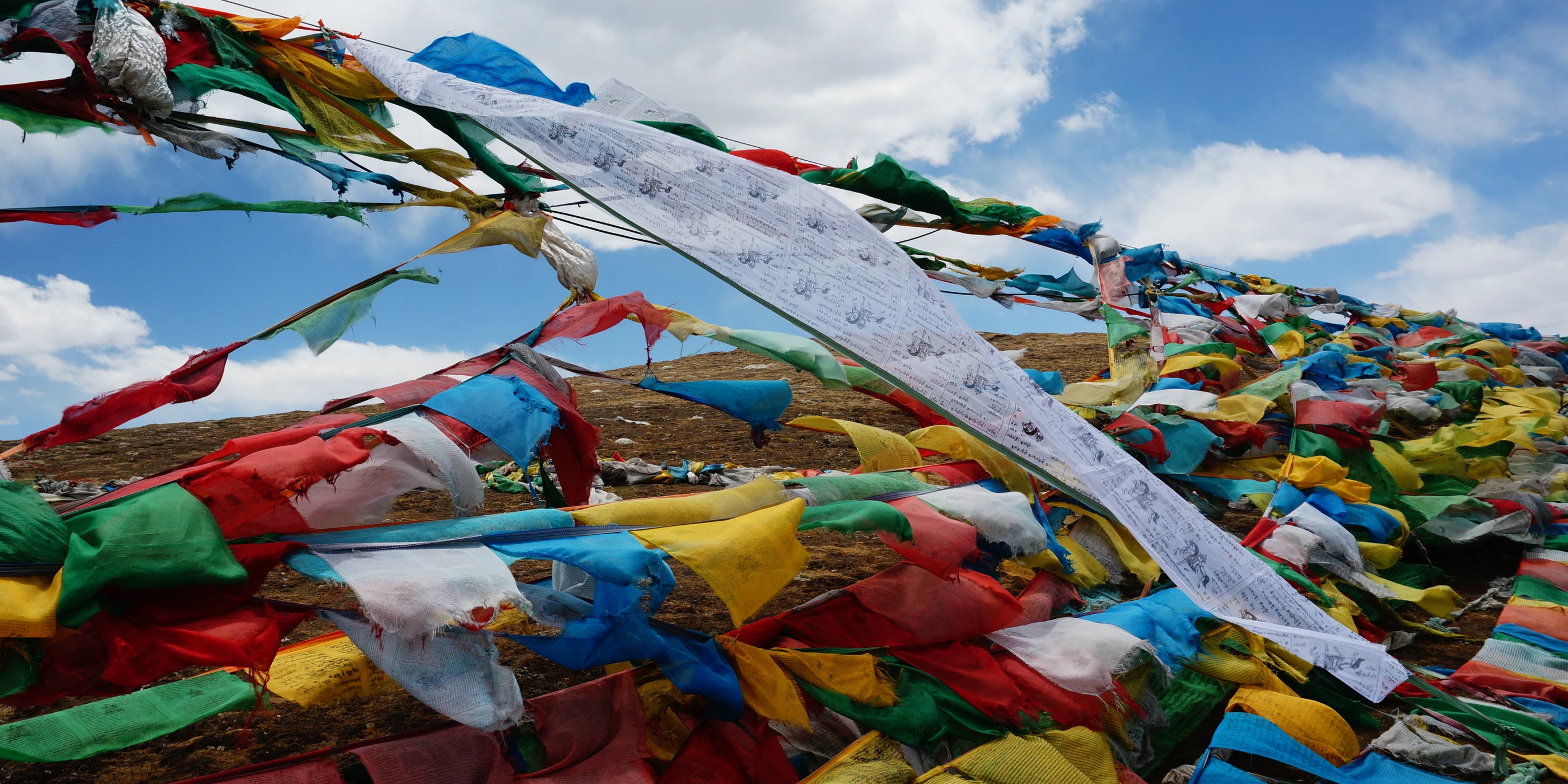
Coloured flags printed with prayers and the wind horse are hung on passes, roofs and bridges so that the wind carries blessings outward. They are a religious practice and are shown here as such.
Losar
The Tibetan New Year, usually in February or March, is the biggest festival of the year, celebrated with family, offerings and fresh prayer flags.