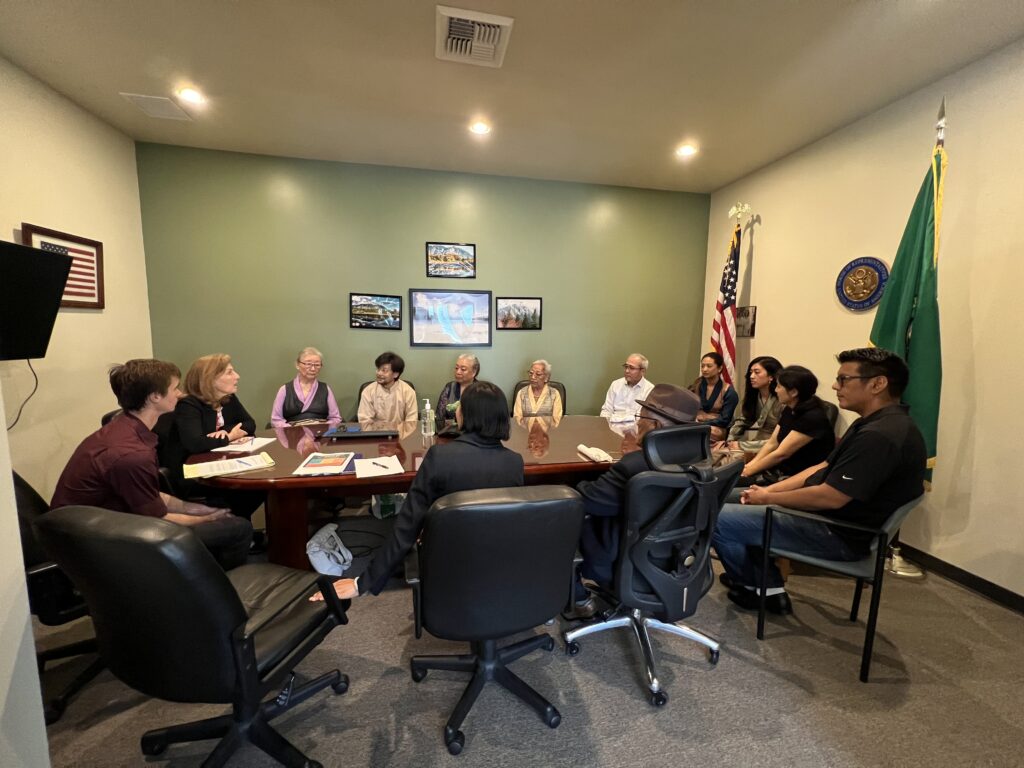
Members of the Tibetan community from Seattle, Washington, accompanied by representatives of the Voluntary Tibet Advocacy Group (V-TAG), met with Congresswoman Kim Schrier on 1 July 2023 to raise concerns about the human rights situation in Tibet and seek her support for the bipartisan Promoting a Resolution to the Tibet-China Conflict Act (H.R. 533). The delegation was led by Passang Bhuti, Advocacy Coordinator for the Tibetan Association of Washington and a V-TAG member.
Congresswoman Schrier spent approximately 30 minutes meeting with the delegation before the group continued discussions with Cody Olsen, a staff member in her office. The meeting provided an opportunity for Tibetan community members to share their concerns, introduce their advocacy activities, and discuss potential avenues for greater congressional engagement on Tibet-related issues.
Raising Awareness of Human Rights and Cultural Preservation
The delegation discussed a range of concerns relating to the situation inside Tibet, including reported human rights violations, restrictions affecting the Tibetan language, environmental degradation, limited access for international media, and challenges to preserving Tibetan cultural and religious traditions.
Participants highlighted the importance of allowing international journalists access to Tibet so that developments on the ground could be independently documented and communicated to the international community. They also discussed restrictions affecting the practice and transmission of Tibetan Buddhism, expressing concern about the implications for the continuity of Tibetan religious traditions.
The delegation further emphasised the responsibility of Tibetan communities in exile to preserve their language, culture, and identity and pass these traditions on to younger generations. The discussion also explored how individual community members could contribute to awareness-building and strengthen public understanding of Tibet in Washington State.
Emphasising Tibet’s Environmental Significance
Environmental concerns formed a central part of the meeting. The delegation raised issues relating to large-scale mining, deforestation, logging, dam construction on major Tibetan rivers, and the displacement of Tibetan farmers and nomadic communities from their traditional lands.
Tsechu Dolma, an environmental law intern, provided a more detailed explanation of the ecological significance of the Tibetan Plateau and its river systems. She highlighted the relationship between Tibet’s environment, regional water security, and global climate systems, and discussed concerns about the consequences of environmental degradation for local communities and traditional ways of life.
The presentation also connected environmental concerns with the preservation of Tibetan culture and language, noting that displacement and changes to traditional livelihoods can affect the continuity of community life. The delegation encouraged greater attention to these issues and stressed the importance of protecting Tibet’s ecological heritage.
Advancing Congressional Engagement on H.R. 533
The delegation also discussed H.R. 533, introduced in the U.S. Congress on 26 January 2023, and explained why members were seeking congressional support for the legislation. The proposed bill was presented as an avenue for encouraging greater U.S. engagement in efforts to address the Tibet-China dispute and promote dialogue.
Congresswoman Schrier showed interest in understanding the delegation’s advocacy work and the challenges Tibetan community members face while raising awareness in Washington. The discussion allowed participants to establish contact with another congressional office and share their perspectives on the political, cultural, religious, and environmental issues affecting Tibet.
The meeting formed part of the Tibetan community’s broader efforts to engage elected representatives, build relationships with congressional offices, and bring Tibet-related concerns into public and legislative discussions. Through these engagements, V-TAG members and community representatives continued their work to raise awareness, encourage informed dialogue, and strengthen connections between Tibetan communities and policymakers in Washington State.