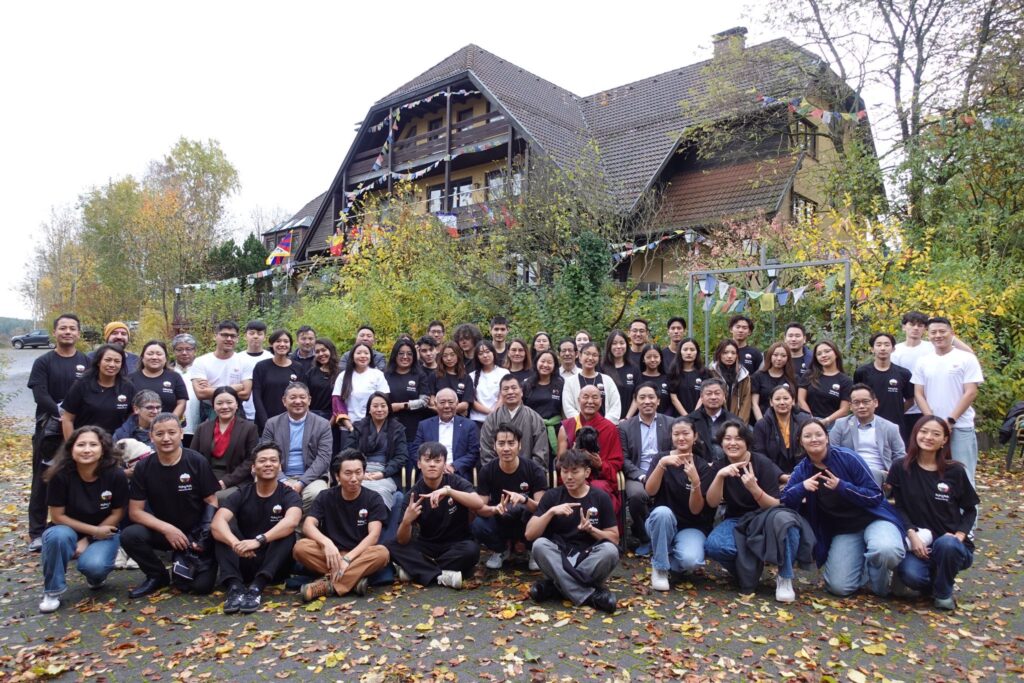
The Department of Information and International Relations (DIIR) of the Central Tibetan Administration successfully concluded the Europe Regional V-TAG Strategic Meeting and Advocacy Training on 5 November 2023 at Retreathaus Berghof, Germany. The meeting brought together 45 members of the Voluntary Tibet Advocacy Group (V-TAG) from nine European countries, alongside Tibetan representatives and delegates from Tibetan associations, to strengthen regional coordination and develop a consolidated framework for Tibet advocacy across Europe.
The gathering was attended by Chithue Ven. Thubten Wangchen and Chithue Thupten Gyatso from Europe; Sonam Tsering Frasi, Representative of the Office of Tibet in London; Rigzin Choedon Genkhang, Representative of the Office of Tibet in Brussels; Thupten Tsering, Coordinator of the Bureau du Tibet in Paris; and Tenzin Lekshay, Additional Secretary of DIIR. Eight representatives of Tibetan associations from seven different countries also participated. V-TAG members represented Austria, Belgium, France, Germany, England, the Netherlands, Poland, Spain, and Switzerland.
Strengthening Regional Advocacy and Strategic Planning
On the second day of the training, Additional Secretary Tenzin Lekshay introduced V-TAG and outlined the importance of initiatives that equip Tibetan youth with the knowledge, organisational capacity, and practical skills required for effective advocacy. Tenzin Palmo, a staff member of DIIR’s Tibet Advocacy Section, followed with a presentation on the action plan developed at the International Tibet Youth Forum 2023 in Dharamshala.
The presentations were followed by an interactive discussion, during which participants raised questions and exchanged perspectives on implementing the proposed initiatives across different European contexts. The session provided a foundation for developing coordinated regional approaches while recognising the distinct opportunities and circumstances of individual countries.
Participants were subsequently divided into country-based groups to develop detailed action plans identifying specific activities and campaigning priorities for the coming months and years. Each group examined the key objectives outlined in the International Tibet Youth Forum Action Plan and discussed practical ways to translate those objectives into locally relevant initiatives. The groups later presented their proposed regional action plans, contributing to a broader exchange of ideas and approaches.
A Consolidated Action Plan for Europe
On the final day, V-TAG members Tenzin Paldon from Poland and Tara Lhamo from London presented a summary of the proposed Europe-wide advocacy action plan. Compiled from drafts submitted by all nine participating countries, the plan reflected a collaborative effort to establish shared priorities and strengthen coordination among V-TAG members throughout Europe.
The country-specific discussions and subsequent consolidation process enabled participants to connect local advocacy initiatives with a common regional framework. This approach aimed to encourage cooperation, improve continuity between national groups, and support more structured campaigning across Europe.
Closing Reflections and Recognition of Youth Leadership
The closing remarks were delivered by Chithue Ven. Thubten Wangchen and Chithue Thupten Gyatso from Europe, Sonam Tsering Frasi of the Office of Tibet in London, and Rigzin C. Genkhang of the Office of Tibet in Brussels. Their participation marked the conclusion of the regional meeting and its collaborative planning process.
Additional Secretary Tenzin Lekshay expressed his sincere appreciation for the valuable contributions made by the younger generation to the Tibetan movement. He acknowledged the active engagement of participants and the importance of their continued involvement in advancing advocacy initiatives.
The Europe Regional V-TAG Strategic Meeting and Advocacy Training concluded with a shared action plan shaped by representatives from nine countries. By bringing together youth volunteers, Tibetan associations, and institutional representatives, the meeting established a foundation for stronger regional cooperation, coordinated campaigning, and sustained Tibet advocacy across Europe.